The openFoam community is growing much faster than anticipated and researchers are pouring in to implement new models, new methods within the openFoam framework for obtaining research specific results.
Good thing is ...the models generated by a researcher in openFoam can be tracked, understood and bettered by another modeler ..Thanks to the universal template.
Recent updates from the openFOAM world can be obtained from
http://www.openfoam.com/news/
One of the new entries into the OF family is the PIMPLE (PISO/SIMPLE merged version)..Not really a new concept though ..take a look at some old publications
http://cat.inist.fr/?aModele=afficheN&cpsidt=2138118.
Some commercial codes like AVL FIRE and others (i cant seem to recollect) - already have similar implementations - combining PISO/SIMPLE etc - working very well for them. FIRE has a two stage pressure correction method which they robustly use for engine applications (did some research on that ..gives more robust results and very stable)..
Some publications based on this PIMPLE have already started to appear on the recent conferences such as this paper:
1. http://web.univ-ubs.fr/limatb/EG2M/Disc_Seminaire/ECCOMAS-CFD2010/papers/01454.pdf
2. A nice article on PIMPLE based solidification modeling using OPENFOAM. The article has nice details of the implementation part. Download it from the link below
http://dutchopenfoamusers.nl/downloads/Eelco1.pdf
3. Different mesh motion alternatives and related implementation has been reported in a article below
http://www.tfd.chalmers.se/~hani/kurser/OS_CFD_2009/AndreuOliverGonzalez/ProjectReport_Corrected.pdf
The above link has some nice (very nice :)) descriptions of equations on how to implement mesh motion in OF...I certainly loved going over these details ..although most of them are familiar to all of us, little re-read is always helpful.
Also, you can browse, read and download all papers of ECCOMAS 2010, which has lots of OF related papers, from
http://web.univ-ubs.fr/limatb/EG2M/Disc_Seminaire/ECCOMAS-CFD2010/papers/
Monday, March 28, 2011


Wednesday, January 26, 2011
Paper & Publications from Conferences
In a recent post, a fellow CFD user posted the following link to a set of CFD papers presented at the 10th International congress of fluid dynamics in Egypt (16-19 Dec, 2010).
Conference topics included:
1. Aeroacoustics.
2. Aero-elasticity Applications.
3. Air Conditioning Applications.
4 Applied Aerodynamics.
5. Computational Fluid Dynamics.
6. Experimental Fluid Dynamics.
7. Flow Control and Diagnostics.
8. Flow-Induced Vibration.
9. Fluid Mechanics Applications in Bioengineering.
10. Heat Transfer and Fluid Mechanics.
11. High-Speed Flow.
12. Mechatronics Applications.
13. MEMS and Microfluidics Applications.
14. Multiphase and Reacting Flows.
15. Nano Applications.
16. Propulsion.
17. Turbomachinery.
The papers can be downloaded from
http://www.icfdpegypt.org/abs_temp.html
Also, interestingly long time back, I came across the australian CSIRO site (http://www.cfd.com.au) where you can download several conference proceedings involving several CFD applications, methods etc
For ex: Get all conference proceedings papers from the
"The 1st International Conference on CFD in the Mineral & Metal Processing and Power Generation Industries"
from http://www.cfd.com.au/cfd_conf97/index.html
Some of the papers are really good and gives lots of prospects for future research in CFD. They have all the papers from conferences starting 1997 till 2009 (so far).
Conference topics included:
1. Aeroacoustics.
2. Aero-elasticity Applications.
3. Air Conditioning Applications.
4 Applied Aerodynamics.
5. Computational Fluid Dynamics.
6. Experimental Fluid Dynamics.
7. Flow Control and Diagnostics.
8. Flow-Induced Vibration.
9. Fluid Mechanics Applications in Bioengineering.
10. Heat Transfer and Fluid Mechanics.
11. High-Speed Flow.
12. Mechatronics Applications.
13. MEMS and Microfluidics Applications.
14. Multiphase and Reacting Flows.
15. Nano Applications.
16. Propulsion.
17. Turbomachinery.
The papers can be downloaded from
http://www.icfdpegypt.org/abs_temp.html
Also, interestingly long time back, I came across the australian CSIRO site (http://www.cfd.com.au) where you can download several conference proceedings involving several CFD applications, methods etc
For ex: Get all conference proceedings papers from the
"The 1st International Conference on CFD in the Mineral & Metal Processing and Power Generation Industries"
from http://www.cfd.com.au/cfd_conf97/index.html
Some of the papers are really good and gives lots of prospects for future research in CFD. They have all the papers from conferences starting 1997 till 2009 (so far).
Thursday, July 1, 2010
FLUENT LEARNING MODULES LINK
I know I have posted similar posts before: but the website presented below has a comprehensive list of learning modules, progressing from a simple to more complex solution using FLUENT.
https://confluence.cornell.edu/display/SIMULATION/FLUENT+Learning+Modules
Great for teaching undergraduates - course ware or even for understanding new CFD fronts !!
Enjoy !!
https://confluence.cornell.edu/display/SIMULATION/FLUENT+Learning+Modules
Great for teaching undergraduates - course ware or even for understanding new CFD fronts !!
Enjoy !!
Wednesday, April 28, 2010
CFD : Wind Turbine Simulations
There has been quite some interest lately in modeling and simulating wind turbine flow using CFD operations. Thought, may be my simulation work in this concern may be of interest. I have attached my sample work on computing local wind turbine blade characteristics as well as the wake characteristics generated by these rotating blades.
Boundary condition and set up

Front View of the blades (Meshed)

I used the comfortable ;) sliding mesh techniques to run transient simulations of the rotating turbine blades. Turbulence activated using RNG k-e model. Ofcourse, I am carrying out some LES runs now to check out more interesting eddy characteristics. But, fundamental framework on this transient process remains the same.
All work reported here were of incompressible nature. Air was used as the fluid medium. Geometry of the turbine was generated using some earlier available models from literature. Ofcourse, more complicated profiles can be built based on specifications.
Contours plots of vorticity magnitude around the rotating blades - various increasing time instants (a-j)

Movie of vorticity shedding near the rotating blades - used FieldView for post-processing (could have been better ;)
Plots of Velocity vector to show local flow characteristics

Wake Flow Studies

I carried out several tests with increasing the incoming fluid flow velocity, changing the rotational speeds etc and interesting flow modification appeared throughout the domain.
This is just a preliminary post. I will keep adding some more information with respect to these simulations. More so, if you have any comments on the modeling and/or application, kindly let me know.
Boundary condition and set up

Front View of the blades (Meshed)
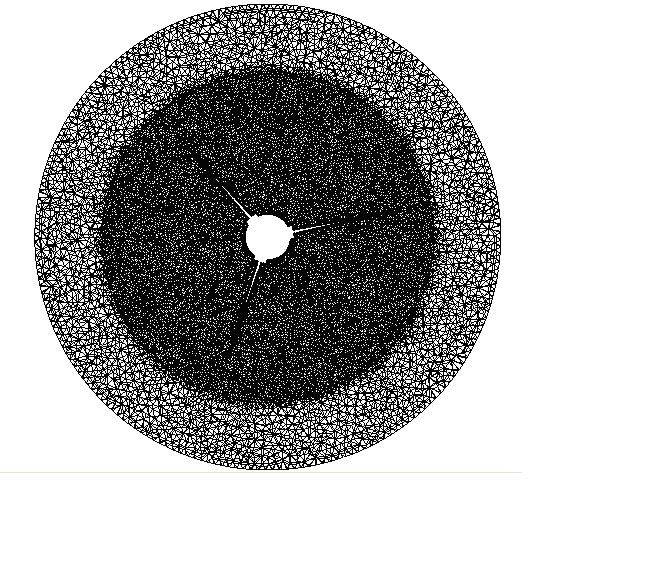
I used the comfortable ;) sliding mesh techniques to run transient simulations of the rotating turbine blades. Turbulence activated using RNG k-e model. Ofcourse, I am carrying out some LES runs now to check out more interesting eddy characteristics. But, fundamental framework on this transient process remains the same.
All work reported here were of incompressible nature. Air was used as the fluid medium. Geometry of the turbine was generated using some earlier available models from literature. Ofcourse, more complicated profiles can be built based on specifications.
Contours plots of vorticity magnitude around the rotating blades - various increasing time instants (a-j)

Movie of vorticity shedding near the rotating blades - used FieldView for post-processing (could have been better ;)
Plots of Velocity vector to show local flow characteristics

Wake Flow Studies

I carried out several tests with increasing the incoming fluid flow velocity, changing the rotational speeds etc and interesting flow modification appeared throughout the domain.
This is just a preliminary post. I will keep adding some more information with respect to these simulations. More so, if you have any comments on the modeling and/or application, kindly let me know.
Wednesday, February 17, 2010
Eulerian Multi-fluid modeling: Developer and User Perspective
Understanding and implementing a multi-fluid model in any software code is a tedious and strenous process. The complication, not only arises owing to coding the procedure, rather to make sure that the system is stable after being washed with multiple "stablizing" approaches such as treatment of implicit drag terms to indicate a few. Often, CFD vendors have a single route for multiphase solution and it takes different forms based on the approach required: such as VOF, Eulerian or mixture type approaches. So, basically a given multiphase code assumes different formulations for fluxes, source / sink terms and induces the need for coupling (only in eulerian multifluid approach) based on the user specification.
Although, most of the users are not quite interested in the "background coding" involved in the blackbox tool, sometimes it becomes essential that they understand the physical significance of the methodology employed.
For example, let me indicate an off the shelf trick to make your eulerian multi-fluid runs much stable. Increasing the drag terms, involved between the phases, results in higher coupling and hence stable runs. Lowering the interaction terms makes the system (or the involved fluids) decoupled and may pose problems for mass convergence. Well, while writing papers people indicate, "enhancement in convergence was obtained by improving the interaction terms between the fluids" - which essentially a developer would read, the left hand side diagonal terms were made dominant :) !!! Such is the essence of CFD - both the user with a physical representation of the phenomena and the developer in a mathematical state of mind can mingle together talking about the same stuff!!
For those who are interested in the formulation part: I am presenting some nice lectures/notes on multi-fluid formulation.
Ofcourse, if you have any comments on the algorithms or suggest different approaches, please feel free to comment - i would be very interested in getting to know new techniques !
Take a look at this website for a decent understanding of the multi-fluid approach
http://www.tnw.tudelft.nl/live/pagina.jsp?id=abc4209a-4a5f-4a77-9121-54850566f33f〈=en
For detailed understanding of the Multi-fluid approach, one can always lean to the Fluent presentation
www.bakker.org/dartmouth06/engs150/18-eulmp.ppt
Modeling of Gas-fluidized systems require very detailed investigation of the drag formulations (although, people tend to think of it more in a physical manner- the truth is ..such systems are extremely unstable owing to the multiple interaction terms and hence a good implicit approach is required to enhance convergence!)
http://www.wpi.edu/Academics/Depts/CHE/Research/HMTL/CFD_in_CRE_IV/vanderHoef.pdf
http://www.princeton.edu/~jsun/docs/Sun06fb.pdf (Formulations in MFIX explained)
A nice presentation of gas-liquid reactor simulation with multiple bubble size distribution
http://cfdcre5.org/cfdcre5-Petitti.pdf with discussion on moments, breakup and coalescence rates ..definitely something worth investigating..
CFD modeling of particulate flows (from the Stanford institute) http://web.engr.oregonstate.edu/~sva/archive/apte_ARB_2003b.pdf
http://www.stanford.edu/group/ctr/Summer/SP08/4_5_Massot2_new.pdf (turbulent combustion part)
Eulerian models for polydisperse evaporating sprays: http://hal.archives-ouvertes.fr/docs/00/44/98/66/PDF/Kah_etal_Pope_final.pdf
I tend to use the keywords such as polydisperse models, dilute sprays, etc so that if one is searching for these keywords over the web, the blog presented here may be useful in finding some relevant papers.
A very nice use of Eulerian multi-fluid modeling for biological transport:
http://www.personal.psu.edu/rfk102/PUBS/BIOMED2003Paper.pdf
Although, most of the users are not quite interested in the "background coding" involved in the blackbox tool, sometimes it becomes essential that they understand the physical significance of the methodology employed.
For example, let me indicate an off the shelf trick to make your eulerian multi-fluid runs much stable. Increasing the drag terms, involved between the phases, results in higher coupling and hence stable runs. Lowering the interaction terms makes the system (or the involved fluids) decoupled and may pose problems for mass convergence. Well, while writing papers people indicate, "enhancement in convergence was obtained by improving the interaction terms between the fluids" - which essentially a developer would read, the left hand side diagonal terms were made dominant :) !!! Such is the essence of CFD - both the user with a physical representation of the phenomena and the developer in a mathematical state of mind can mingle together talking about the same stuff!!
For those who are interested in the formulation part: I am presenting some nice lectures/notes on multi-fluid formulation.
Ofcourse, if you have any comments on the algorithms or suggest different approaches, please feel free to comment - i would be very interested in getting to know new techniques !
Take a look at this website for a decent understanding of the multi-fluid approach
http://www.tnw.tudelft.nl/live/pagina.jsp?id=abc4209a-4a5f-4a77-9121-54850566f33f〈=en
For detailed understanding of the Multi-fluid approach, one can always lean to the Fluent presentation
www.bakker.org/dartmouth06/engs150/18-eulmp.ppt
Modeling of Gas-fluidized systems require very detailed investigation of the drag formulations (although, people tend to think of it more in a physical manner- the truth is ..such systems are extremely unstable owing to the multiple interaction terms and hence a good implicit approach is required to enhance convergence!)
http://www.wpi.edu/Academics/Depts/CHE/Research/HMTL/CFD_in_CRE_IV/vanderHoef.pdf
http://www.princeton.edu/~jsun/docs/Sun06fb.pdf (Formulations in MFIX explained)
A nice presentation of gas-liquid reactor simulation with multiple bubble size distribution
http://cfdcre5.org/cfdcre5-Petitti.pdf with discussion on moments, breakup and coalescence rates ..definitely something worth investigating..
CFD modeling of particulate flows (from the Stanford institute) http://web.engr.oregonstate.edu/~sva/archive/apte_ARB_2003b.pdf
http://www.stanford.edu/group/ctr/Summer/SP08/4_5_Massot2_new.pdf (turbulent combustion part)
Eulerian models for polydisperse evaporating sprays: http://hal.archives-ouvertes.fr/docs/00/44/98/66/PDF/Kah_etal_Pope_final.pdf
I tend to use the keywords such as polydisperse models, dilute sprays, etc so that if one is searching for these keywords over the web, the blog presented here may be useful in finding some relevant papers.
A very nice use of Eulerian multi-fluid modeling for biological transport:
http://www.personal.psu.edu/rfk102/PUBS/BIOMED2003Paper.pdf
Subscribe to:
Comments (Atom)