The 24th European conference on liquid atomization and spray systems took place from Sep 5-7 2011 in portugal.
Site link: http://www.ilass2011.org/programme.asp
Very nice papers were presented and interestingly enough, all the papers have been made public, downloadable and usable. Great!
Topics of interest include: numerical simulation of jets, sprays, heat transfer, phase change and experiments on the spray systems. I follow both ILASS and ICLASS conference with great interest. Some of the papers easily make it into Atomization and sprays Journal!
For someone interested in engine modeling (combustion, sprays, engine design etc), this is a perfect place to be associated with.
The conference is very good and provides nice collaborative atmosphere. And more importantly dont forget, for young researchers from universities, it is possible to get fund for traveling to the conference
Take a look here: http://www.ilass2011.org/travel_awards.asp and make use of this. All you need to do is send Resume and apply!
ofcourse, you can browse previous ILASS Europe conference presentations and download them single or completely (zipped files) from http://www.ilasseurope.org/ILASSconfs.html
I have some more material to share on spray and other Multiphase modeling items which I will post as soon as possible.
If you have any related publication material for showcase, please comment on the blog and post link to your research site, thesis or publication link.
Showing posts with label CFD. Show all posts
Showing posts with label CFD. Show all posts
Friday, September 16, 2011


Thursday, May 19, 2011
Porous media flows
One of the foremost challenging topics that has found wide applicability deals with the flow in porous media. The topic has been, time and again, researched with great interest. I have done my share of flow simulations involving porous media and, uptodate, havent figured out "one particular" global model that can be used in a universal manner. It is understandable to assume that every single porous media flow is different and the complexities associated with the interactions within the systems are not easily resolved..Still, to me, using different models for different systems and not able to combine them all together indicates that the fundamental research in this area needs serious revision.
Information on multi scale modelling in porous media can be obtained here http://www.porous-media.org/
A nice handout on porous media here: http://www.columbia.edu/~rl268/ChESite/E3110/Handout_15.pdf
Texas A&M has a nice list of publication reports involving different simulation analysis.
http://www.isc.tamu.edu/publications-reports/tr
Bad that they did not name files easy to open and read as per need. Sample file on porous media: http://isc.tamu.edu/publications-reports/tr/9706.pdf
Another nice website with several papers/documents/files on porous media flows can be found here: http://www.win.tue.nl/macsi-net/Events/
One of Prof. Joseph's page with several papers on cavitation and fundamental fluid dynamics, also has some papers on porous media
(see http://www.aem.umn.edu/people/faculty/joseph/papers/) - the paper is modeling foamy flow in porous media (http://www.aem.umn.edu/people/faculty/joseph/papers/foamyOils3.pdf)
a nice paper for definite reference and further research http://library.wrds.uwyo.edu/wrp/85-37/85-37.pdf
Several softwares are now adept in carrying out flows through porous mediums. ANSYS,STAR,Flow3D,FIRE,openFoam(:),Polyflow(?) - all have a variety of models in-built. Again, directions of usage is based on particular application where the terms involved in the transport equations will be treated appropriately. Based on my experience in coding porous flows, fundamental changes (the GUI in softwares) let you do is to adjust the pressure gradient (based on some interactions) and the drag coefficients. As written in my earlier blog, drag coefficients play a pivotal role in producing excellent convergence and stability rates owing to the nature of the set up of the solution matrix.
A sample FLOW3D movie (Finite Volume method) - Read Flow3D paper on flow through unsaturated porous media here: http://www.flow3d.com/pdfs/tn/FloSci-TN25R.pdf
Youtube video: http://www.youtube.com/watch?v=jszmSsF2gDI
Get more flow3D based runs here: http://wn.com/Modeling_Porous_Media_with_FLOW-3D
Doing porous media flows using Lattice boltzmann !!
http://www.youtube.com/watch?v=F7j8C5-m430&feature=related
I found the following site - http://www.engr.ucr.edu/~vafai/Publications/ very useful. They have a long list of papers on heat and mass transfer with a lot of publications/book chapters on porous media flows.
Modeling and simulating your own porous media flow is now possible - thanks to openFoam !! A sample modeling capability detail is presented here
http://www.tfd.chalmers.se/~hani/kurser/OS_CFD_2008/HaukurElvarHafsteinsson/haukurReport.pdf
I followed this researcher : http://www.ifd.mavt.ethz.ch/people/hajibeygi/index with some nice information in the site.
There are loads of papers on multiphase flow modeling in Heterogenous porous media, porous medium flows with fractional distillations, fractured media - with and without turbulence - how complicated can these get??
Information on multi scale modelling in porous media can be obtained here http://www.porous-media.org/
A nice handout on porous media here: http://www.columbia.edu/~rl268/ChESite/E3110/Handout_15.pdf
Texas A&M has a nice list of publication reports involving different simulation analysis.
http://www.isc.tamu.edu/publications-reports/tr
Bad that they did not name files easy to open and read as per need. Sample file on porous media: http://isc.tamu.edu/publications-reports/tr/9706.pdf
Another nice website with several papers/documents/files on porous media flows can be found here: http://www.win.tue.nl/macsi-net/Events/
One of Prof. Joseph's page with several papers on cavitation and fundamental fluid dynamics, also has some papers on porous media
(see http://www.aem.umn.edu/people/faculty/joseph/papers/) - the paper is modeling foamy flow in porous media (http://www.aem.umn.edu/people/faculty/joseph/papers/foamyOils3.pdf)
a nice paper for definite reference and further research http://library.wrds.uwyo.edu/wrp/85-37/85-37.pdf
Several softwares are now adept in carrying out flows through porous mediums. ANSYS,STAR,Flow3D,FIRE,openFoam(:),Polyflow(?) - all have a variety of models in-built. Again, directions of usage is based on particular application where the terms involved in the transport equations will be treated appropriately. Based on my experience in coding porous flows, fundamental changes (the GUI in softwares) let you do is to adjust the pressure gradient (based on some interactions) and the drag coefficients. As written in my earlier blog, drag coefficients play a pivotal role in producing excellent convergence and stability rates owing to the nature of the set up of the solution matrix.
A sample FLOW3D movie (Finite Volume method) - Read Flow3D paper on flow through unsaturated porous media here: http://www.flow3d.com/pdfs/tn/FloSci-TN25R.pdf
Youtube video: http://www.youtube.com/watch?v=jszmSsF2gDI
Get more flow3D based runs here: http://wn.com/Modeling_Porous_Media_with_FLOW-3D
Doing porous media flows using Lattice boltzmann !!
http://www.youtube.com/watch?v=F7j8C5-m430&feature=related
I found the following site - http://www.engr.ucr.edu/~vafai/Publications/ very useful. They have a long list of papers on heat and mass transfer with a lot of publications/book chapters on porous media flows.
Modeling and simulating your own porous media flow is now possible - thanks to openFoam !! A sample modeling capability detail is presented here
http://www.tfd.chalmers.se/~hani/kurser/OS_CFD_2008/HaukurElvarHafsteinsson/haukurReport.pdf
I followed this researcher : http://www.ifd.mavt.ethz.ch/people/hajibeygi/index with some nice information in the site.
There are loads of papers on multiphase flow modeling in Heterogenous porous media, porous medium flows with fractional distillations, fractured media - with and without turbulence - how complicated can these get??
Tuesday, May 17, 2011
More on Testing / Validation / Verification
Once the modeling and implementation part is worked out, the most critical and important phase of the code development stares at us. Yes, you guessed it right. The validation part !!
Most often, what is coded in the software (on a theoretical basis) involving detailed physical approximations of a global phenomenon is directly tested against well known "experiments" and "test cases". During the testing (which is pretty much making sure code does what it is supposed to) and later, the validation (where the model is supposed to mimic a process) process, the developer/coder realizes that more approximations or model adjustments is necessary to satisfy the user!!
Stability, convergence, accuracy are all dealt with in the validation process. If the code is made to work on a variety of test cases and the coder, who is the best critique of his own work, tries to break the code by providing a wide range of operating parameters. With every input, the developer monitors the behavior of the code - as to what happens when the code confronts certain aspects of numerical deficiencies or challenges based on the input defined.
Every test case is unique in the sense that it offers a completely new perspective of the modeling process - what the model lacks and what additional effects needs to be incorporated etc. It is not an easy process. No way. However, as a rule of thumb, modelers start by applying the code to smaller domains and escalate the size and complexity of the process as they move into advanced testing/validation process.
For example, once you have developed a "boiling model" - it makes no sense to directly apply it into a large scale channel flows with high complexity when no tests have been run on smaller channels/ducts and compared with experiments. Sometimes, in fact many times should I say, going across different scales and applying the codes, one figures out that some "problems" are often masked by other parameters operating in the system. Only by running the procedure on a wide range of scenarios can one explicitly make sure all modeling constraints act as per plan and their interactions are stable.
A small discussion is available here: http://www.innovative-cfd.com/cfd-validation.html
This site shares some well known validation resources
NPARC Alliance CFD Verification and Validation Web Site: http://www.grc.nasa.gov/WWW/wind/valid/homepage.html
AIAA CFD Drag Prediction Workshop: http://aaac.larc.nasa.gov/tsab/cfdlarc/aiaa-dpw/
CFL3D Test/Validation Cases: http://cfl3d.larc.nasa.gov/Cfl3dv6/cfl3dv6_testcases.html
Sample validation/testing (exp) study links
1. CFD model validation for hydrogen dispersion: Nice study - http://www.gexcon.com/doc//PDF%20files/Middha_Hansen_Storvilk_HydrogenDispersion_09.pdf
2. Stirred vessel mixing test case study released by ANSYS: http://www.bakker.org/cfm/publications/tn253.pdf
3. Often wind tunnel experiments and studies form a large portion of the CFD testing and validation database: I came across one of these sites

http://ftp.rta.nato.int/public//PubFulltext/RTO/TR/RTO-TR-027///$TR-027-02.pdf
4. How about a CFD evaluation study of wind tunnel flow quality itself !!?
http://sts.bwk.tue.nl/UrbanPhysics/CFD_windtunnel.htm
5. one of the openfoam based WIKI has a site for multiphase activities: http://openfoamwiki.net/index.php/Sig_Multiphase
6. I am no supporter of any particular book / reference..recently had a chance to look at this book ("Validation of Advanced Computational Methods for Multiphase Flow", C2005). It was a nice collection of the test cases (fairly well known to most of us)
http://www.begellhouse.com/books/709c03c830e1b733
I found this article sometime ago on the "general BEST practices guide for numerical accuracy"
http://www.kxcad.net/ansys/ANSYS_CFX/help/help/Reference/CDDDFGCH.html
Coding and implementation is one part of the puzzle. Without validation and testing, no software package is complete. (No wonder so many job availability for validation and testing are on the rise !! Customers want to see more validation reports / testing reports before they award any contract to potential CFD consulting services or the big players)
Make sure whatever you code -----> is properly validated.
Most often, what is coded in the software (on a theoretical basis) involving detailed physical approximations of a global phenomenon is directly tested against well known "experiments" and "test cases". During the testing (which is pretty much making sure code does what it is supposed to) and later, the validation (where the model is supposed to mimic a process) process, the developer/coder realizes that more approximations or model adjustments is necessary to satisfy the user!!
Stability, convergence, accuracy are all dealt with in the validation process. If the code is made to work on a variety of test cases and the coder, who is the best critique of his own work, tries to break the code by providing a wide range of operating parameters. With every input, the developer monitors the behavior of the code - as to what happens when the code confronts certain aspects of numerical deficiencies or challenges based on the input defined.
Every test case is unique in the sense that it offers a completely new perspective of the modeling process - what the model lacks and what additional effects needs to be incorporated etc. It is not an easy process. No way. However, as a rule of thumb, modelers start by applying the code to smaller domains and escalate the size and complexity of the process as they move into advanced testing/validation process.
For example, once you have developed a "boiling model" - it makes no sense to directly apply it into a large scale channel flows with high complexity when no tests have been run on smaller channels/ducts and compared with experiments. Sometimes, in fact many times should I say, going across different scales and applying the codes, one figures out that some "problems" are often masked by other parameters operating in the system. Only by running the procedure on a wide range of scenarios can one explicitly make sure all modeling constraints act as per plan and their interactions are stable.
A small discussion is available here: http://www.innovative-cfd.com/cfd-validation.html
This site shares some well known validation resources
NPARC Alliance CFD Verification and Validation Web Site: http://www.grc.nasa.gov/WWW/wind/valid/homepage.html
AIAA CFD Drag Prediction Workshop: http://aaac.larc.nasa.gov/tsab/cfdlarc/aiaa-dpw/
CFL3D Test/Validation Cases: http://cfl3d.larc.nasa.gov/Cfl3dv6/cfl3dv6_testcases.html
Sample validation/testing (exp) study links
1. CFD model validation for hydrogen dispersion: Nice study - http://www.gexcon.com/doc//PDF%20files/Middha_Hansen_Storvilk_HydrogenDispersion_09.pdf
2. Stirred vessel mixing test case study released by ANSYS: http://www.bakker.org/cfm/publications/tn253.pdf
3. Often wind tunnel experiments and studies form a large portion of the CFD testing and validation database: I came across one of these sites
http://ftp.rta.nato.int/public//PubFulltext/RTO/TR/RTO-TR-027///$TR-027-02.pdf
4. How about a CFD evaluation study of wind tunnel flow quality itself !!?
http://sts.bwk.tue.nl/UrbanPhysics/CFD_windtunnel.htm
5. one of the openfoam based WIKI has a site for multiphase activities: http://openfoamwiki.net/index.php/Sig_Multiphase
6. I am no supporter of any particular book / reference..recently had a chance to look at this book ("Validation of Advanced Computational Methods for Multiphase Flow", C2005). It was a nice collection of the test cases (fairly well known to most of us)
http://www.begellhouse.com/books/709c03c830e1b733
I found this article sometime ago on the "general BEST practices guide for numerical accuracy"
http://www.kxcad.net/ansys/ANSYS_CFX/help/help/Reference/CDDDFGCH.html
Coding and implementation is one part of the puzzle. Without validation and testing, no software package is complete. (No wonder so many job availability for validation and testing are on the rise !! Customers want to see more validation reports / testing reports before they award any contract to potential CFD consulting services or the big players)
Make sure whatever you code -----> is properly validated.
Wednesday, April 28, 2010
CFD : Wind Turbine Simulations
There has been quite some interest lately in modeling and simulating wind turbine flow using CFD operations. Thought, may be my simulation work in this concern may be of interest. I have attached my sample work on computing local wind turbine blade characteristics as well as the wake characteristics generated by these rotating blades.
Boundary condition and set up

Front View of the blades (Meshed)

I used the comfortable ;) sliding mesh techniques to run transient simulations of the rotating turbine blades. Turbulence activated using RNG k-e model. Ofcourse, I am carrying out some LES runs now to check out more interesting eddy characteristics. But, fundamental framework on this transient process remains the same.
All work reported here were of incompressible nature. Air was used as the fluid medium. Geometry of the turbine was generated using some earlier available models from literature. Ofcourse, more complicated profiles can be built based on specifications.
Contours plots of vorticity magnitude around the rotating blades - various increasing time instants (a-j)

Movie of vorticity shedding near the rotating blades - used FieldView for post-processing (could have been better ;)
Plots of Velocity vector to show local flow characteristics

Wake Flow Studies

I carried out several tests with increasing the incoming fluid flow velocity, changing the rotational speeds etc and interesting flow modification appeared throughout the domain.
This is just a preliminary post. I will keep adding some more information with respect to these simulations. More so, if you have any comments on the modeling and/or application, kindly let me know.
Boundary condition and set up

Front View of the blades (Meshed)
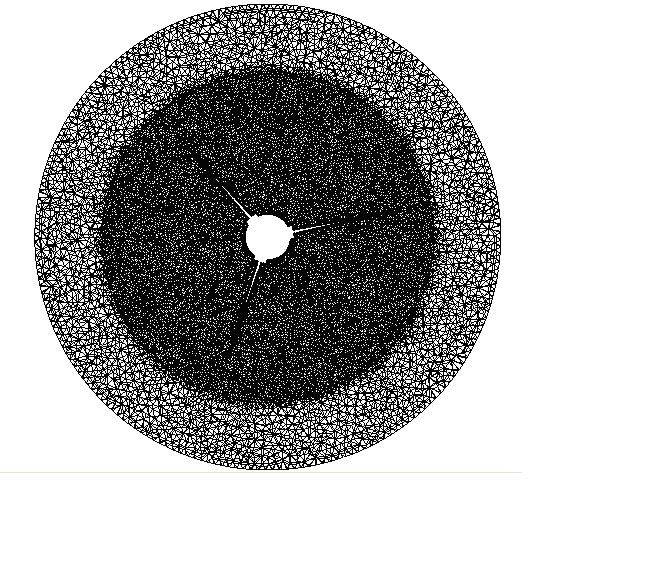
I used the comfortable ;) sliding mesh techniques to run transient simulations of the rotating turbine blades. Turbulence activated using RNG k-e model. Ofcourse, I am carrying out some LES runs now to check out more interesting eddy characteristics. But, fundamental framework on this transient process remains the same.
All work reported here were of incompressible nature. Air was used as the fluid medium. Geometry of the turbine was generated using some earlier available models from literature. Ofcourse, more complicated profiles can be built based on specifications.
Contours plots of vorticity magnitude around the rotating blades - various increasing time instants (a-j)

Movie of vorticity shedding near the rotating blades - used FieldView for post-processing (could have been better ;)
Plots of Velocity vector to show local flow characteristics

Wake Flow Studies

I carried out several tests with increasing the incoming fluid flow velocity, changing the rotational speeds etc and interesting flow modification appeared throughout the domain.
This is just a preliminary post. I will keep adding some more information with respect to these simulations. More so, if you have any comments on the modeling and/or application, kindly let me know.
Subscribe to:
Posts (Atom)