I recently came across this site http://www.cfse.ch/cfse/site/openfoam.php which uses openFoam for several multiphase applications such as free surface VOF modeling of flows around Motor yacht, hydrodynamica analysis of submerged propeller and several other interesting items.
Safe enough to say, the OF users count has swelled quite dramatically over the years. From the interactions I have had with researchers, a lot of them are quite satisfied with the already existing modules (REMEMBER - FREE TO USE) available from OpenFoam installation. Guess what, with every new release the developers keep adding new "foam modules" in every section combustion, multiphase, incompressible/compressible etc..have you checked out the latest release.
I was not quite following the latest release and when I did, I was quite amazed by the amount of additional features OF has incorporated and again "FREE TO USE AND DEVELOP" !!!
Now, several organizations (sometimes I provide consultations) have now resorted to the use of OPENFOAM as their primary investigation tool - giving the clients, specific developmental modules as deliverables. For example, recently I modeled evaporative boiling in cooling water jackets for automotive boiling flow applications and provided source codes as a deliverable. All the client had to do was take this, place it in their directory and compile it.
They built their own manual - indicating what properties has to be varies inclusive of constants and "fudge factors" which we often provide to take into account the dynamics in such multiphase calculations.
Now big interactive GUIs, no fancy JAVA interfaces, simply editing of the file using a word editor - notepad, VIM (linux) and guess what they have modified the "run" file. What an ease !
Some boiling flow simulations using openFoam with VOF with numerical modeling issues is available here for discussion
http://www.csi.tu-darmstadt.de/media/csi/news_1/dbdopenfoamworkshop/kunkelmann_20090407_csi_openfoam_workshop_kunkelmann.pdf
Take a look at a recent plan, http://virtual.vtt.fi/virtual/safir2010/vasenpalkki/finalseminar/Presentations/Thursday/Area_4/NuFoam_SAFIR2010.pdf
that one of the institutes has for Foam two phase solver development. Simply terrific potential they see in this source codes.
Article by Jasak (Foam developer) on the opensource CFD in industry and research is a nice article i suggest reading
http://210.98.5.85/index.php/jnaoe/article/viewFile/24/pdf2-5
with so much wealth and abundancy of information in the web on openfoam - I wonder where is this heading ?? Will ANSYS try "purchasing" openfoam code release and development to retain its monopoly !!>>
Friday, May 6, 2011


Monday, March 28, 2011
OpenFoam news and update
The openFoam community is growing much faster than anticipated and researchers are pouring in to implement new models, new methods within the openFoam framework for obtaining research specific results.
Good thing is ...the models generated by a researcher in openFoam can be tracked, understood and bettered by another modeler ..Thanks to the universal template.
Recent updates from the openFOAM world can be obtained from
http://www.openfoam.com/news/
One of the new entries into the OF family is the PIMPLE (PISO/SIMPLE merged version)..Not really a new concept though ..take a look at some old publications
http://cat.inist.fr/?aModele=afficheN&cpsidt=2138118.
Some commercial codes like AVL FIRE and others (i cant seem to recollect) - already have similar implementations - combining PISO/SIMPLE etc - working very well for them. FIRE has a two stage pressure correction method which they robustly use for engine applications (did some research on that ..gives more robust results and very stable)..
Some publications based on this PIMPLE have already started to appear on the recent conferences such as this paper:
1. http://web.univ-ubs.fr/limatb/EG2M/Disc_Seminaire/ECCOMAS-CFD2010/papers/01454.pdf
2. A nice article on PIMPLE based solidification modeling using OPENFOAM. The article has nice details of the implementation part. Download it from the link below
http://dutchopenfoamusers.nl/downloads/Eelco1.pdf
3. Different mesh motion alternatives and related implementation has been reported in a article below
http://www.tfd.chalmers.se/~hani/kurser/OS_CFD_2009/AndreuOliverGonzalez/ProjectReport_Corrected.pdf
The above link has some nice (very nice :)) descriptions of equations on how to implement mesh motion in OF...I certainly loved going over these details ..although most of them are familiar to all of us, little re-read is always helpful.
Also, you can browse, read and download all papers of ECCOMAS 2010, which has lots of OF related papers, from
http://web.univ-ubs.fr/limatb/EG2M/Disc_Seminaire/ECCOMAS-CFD2010/papers/
Good thing is ...the models generated by a researcher in openFoam can be tracked, understood and bettered by another modeler ..Thanks to the universal template.
Recent updates from the openFOAM world can be obtained from
http://www.openfoam.com/news/
One of the new entries into the OF family is the PIMPLE (PISO/SIMPLE merged version)..Not really a new concept though ..take a look at some old publications
http://cat.inist.fr/?aModele=afficheN&cpsidt=2138118.
Some commercial codes like AVL FIRE and others (i cant seem to recollect) - already have similar implementations - combining PISO/SIMPLE etc - working very well for them. FIRE has a two stage pressure correction method which they robustly use for engine applications (did some research on that ..gives more robust results and very stable)..
Some publications based on this PIMPLE have already started to appear on the recent conferences such as this paper:
1. http://web.univ-ubs.fr/limatb/EG2M/Disc_Seminaire/ECCOMAS-CFD2010/papers/01454.pdf
2. A nice article on PIMPLE based solidification modeling using OPENFOAM. The article has nice details of the implementation part. Download it from the link below
http://dutchopenfoamusers.nl/downloads/Eelco1.pdf
3. Different mesh motion alternatives and related implementation has been reported in a article below
http://www.tfd.chalmers.se/~hani/kurser/OS_CFD_2009/AndreuOliverGonzalez/ProjectReport_Corrected.pdf
The above link has some nice (very nice :)) descriptions of equations on how to implement mesh motion in OF...I certainly loved going over these details ..although most of them are familiar to all of us, little re-read is always helpful.
Also, you can browse, read and download all papers of ECCOMAS 2010, which has lots of OF related papers, from
http://web.univ-ubs.fr/limatb/EG2M/Disc_Seminaire/ECCOMAS-CFD2010/papers/
Wednesday, January 26, 2011
Paper & Publications from Conferences
In a recent post, a fellow CFD user posted the following link to a set of CFD papers presented at the 10th International congress of fluid dynamics in Egypt (16-19 Dec, 2010).
Conference topics included:
1. Aeroacoustics.
2. Aero-elasticity Applications.
3. Air Conditioning Applications.
4 Applied Aerodynamics.
5. Computational Fluid Dynamics.
6. Experimental Fluid Dynamics.
7. Flow Control and Diagnostics.
8. Flow-Induced Vibration.
9. Fluid Mechanics Applications in Bioengineering.
10. Heat Transfer and Fluid Mechanics.
11. High-Speed Flow.
12. Mechatronics Applications.
13. MEMS and Microfluidics Applications.
14. Multiphase and Reacting Flows.
15. Nano Applications.
16. Propulsion.
17. Turbomachinery.
The papers can be downloaded from
http://www.icfdpegypt.org/abs_temp.html
Also, interestingly long time back, I came across the australian CSIRO site (http://www.cfd.com.au) where you can download several conference proceedings involving several CFD applications, methods etc
For ex: Get all conference proceedings papers from the
"The 1st International Conference on CFD in the Mineral & Metal Processing and Power Generation Industries"
from http://www.cfd.com.au/cfd_conf97/index.html
Some of the papers are really good and gives lots of prospects for future research in CFD. They have all the papers from conferences starting 1997 till 2009 (so far).
Conference topics included:
1. Aeroacoustics.
2. Aero-elasticity Applications.
3. Air Conditioning Applications.
4 Applied Aerodynamics.
5. Computational Fluid Dynamics.
6. Experimental Fluid Dynamics.
7. Flow Control and Diagnostics.
8. Flow-Induced Vibration.
9. Fluid Mechanics Applications in Bioengineering.
10. Heat Transfer and Fluid Mechanics.
11. High-Speed Flow.
12. Mechatronics Applications.
13. MEMS and Microfluidics Applications.
14. Multiphase and Reacting Flows.
15. Nano Applications.
16. Propulsion.
17. Turbomachinery.
The papers can be downloaded from
http://www.icfdpegypt.org/abs_temp.html
Also, interestingly long time back, I came across the australian CSIRO site (http://www.cfd.com.au) where you can download several conference proceedings involving several CFD applications, methods etc
For ex: Get all conference proceedings papers from the
"The 1st International Conference on CFD in the Mineral & Metal Processing and Power Generation Industries"
from http://www.cfd.com.au/cfd_conf97/index.html
Some of the papers are really good and gives lots of prospects for future research in CFD. They have all the papers from conferences starting 1997 till 2009 (so far).
Thursday, July 1, 2010
FLUENT LEARNING MODULES LINK
I know I have posted similar posts before: but the website presented below has a comprehensive list of learning modules, progressing from a simple to more complex solution using FLUENT.
https://confluence.cornell.edu/display/SIMULATION/FLUENT+Learning+Modules
Great for teaching undergraduates - course ware or even for understanding new CFD fronts !!
Enjoy !!
https://confluence.cornell.edu/display/SIMULATION/FLUENT+Learning+Modules
Great for teaching undergraduates - course ware or even for understanding new CFD fronts !!
Enjoy !!
Wednesday, April 28, 2010
CFD : Wind Turbine Simulations
There has been quite some interest lately in modeling and simulating wind turbine flow using CFD operations. Thought, may be my simulation work in this concern may be of interest. I have attached my sample work on computing local wind turbine blade characteristics as well as the wake characteristics generated by these rotating blades.
Boundary condition and set up

Front View of the blades (Meshed)

I used the comfortable ;) sliding mesh techniques to run transient simulations of the rotating turbine blades. Turbulence activated using RNG k-e model. Ofcourse, I am carrying out some LES runs now to check out more interesting eddy characteristics. But, fundamental framework on this transient process remains the same.
All work reported here were of incompressible nature. Air was used as the fluid medium. Geometry of the turbine was generated using some earlier available models from literature. Ofcourse, more complicated profiles can be built based on specifications.
Contours plots of vorticity magnitude around the rotating blades - various increasing time instants (a-j)

Movie of vorticity shedding near the rotating blades - used FieldView for post-processing (could have been better ;)
Plots of Velocity vector to show local flow characteristics

Wake Flow Studies

I carried out several tests with increasing the incoming fluid flow velocity, changing the rotational speeds etc and interesting flow modification appeared throughout the domain.
This is just a preliminary post. I will keep adding some more information with respect to these simulations. More so, if you have any comments on the modeling and/or application, kindly let me know.
Boundary condition and set up

Front View of the blades (Meshed)
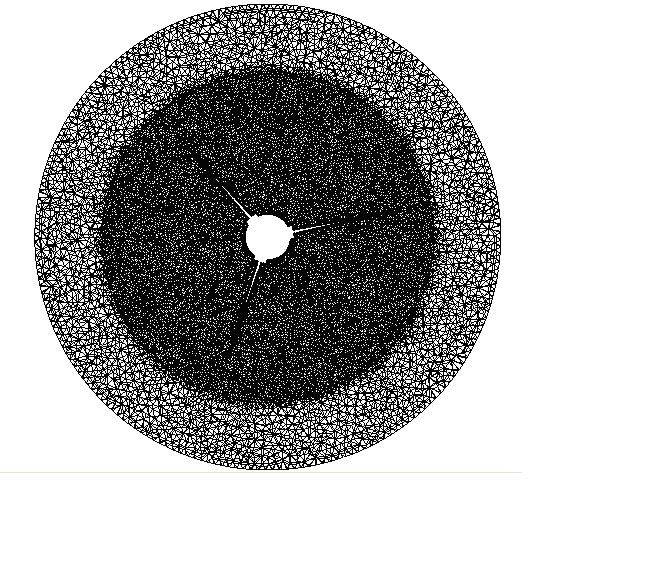
I used the comfortable ;) sliding mesh techniques to run transient simulations of the rotating turbine blades. Turbulence activated using RNG k-e model. Ofcourse, I am carrying out some LES runs now to check out more interesting eddy characteristics. But, fundamental framework on this transient process remains the same.
All work reported here were of incompressible nature. Air was used as the fluid medium. Geometry of the turbine was generated using some earlier available models from literature. Ofcourse, more complicated profiles can be built based on specifications.
Contours plots of vorticity magnitude around the rotating blades - various increasing time instants (a-j)

Movie of vorticity shedding near the rotating blades - used FieldView for post-processing (could have been better ;)
Plots of Velocity vector to show local flow characteristics

Wake Flow Studies

I carried out several tests with increasing the incoming fluid flow velocity, changing the rotational speeds etc and interesting flow modification appeared throughout the domain.
This is just a preliminary post. I will keep adding some more information with respect to these simulations. More so, if you have any comments on the modeling and/or application, kindly let me know.
Subscribe to:
Posts (Atom)